

Change Crew – Change Country
July/Aug 2023
We had a 2 day crossover when our good friend Steve Halliday arrived and while we waited for the latest Meltemi to abate. This was a great chance to visit the small nearby island of Antiparos by road and ferry, it being far too windy for us to sail there, as it is not on our route when we leave Paros.

The island of Antiparos is located 0.8 nautical mi (1.5 km) southwest of Paros, separated by the Strait of Antiparos. The etymology of the name derives from its geographical position being situated opposite (αντί – Anti) the nearby island of Paros. The small island of Antiparos is only 11 km long by 4.5 km wide and is serviced by several car/passenger ferries per day across the straits of Antiparos – a mere 1km voyage for the princely sum of EUR 2 to see the most famous attraction on the island – the Antiparos Cave (also known as The Cave of Agios Ioannis church).
Antiparos Cave is the only vertical cave in all of Europe with a depth of approximately 85 meters and contains the oldest stalactite in Europe estimated to be 45 million years old. After the 8 km bus ride to the top of a mountain in the central southern part of the island we arrived at the imposing entrance with it’s cute little Greek church. Inside the cave the temperature was so much cooler and surprisingly humid. The walk down 400+ concrete steps (with handrails) takes you through three main chambers to the bottom of the cave – it’s a long climb back up again. The stalagmites and stalactites are impressive and the scale of the cave is awe inspiring – the widest area is 60 metres wide so it’s not at all claustrophobic. When you descend the stairs you can see small figures way down on the walkways below (zoom in on the photos)! The whole area was renovated in the early 2000’s with EU money when they installed the new concrete stairs and lighting throughout making it safe and accessible to most able bodied people.
Patmos
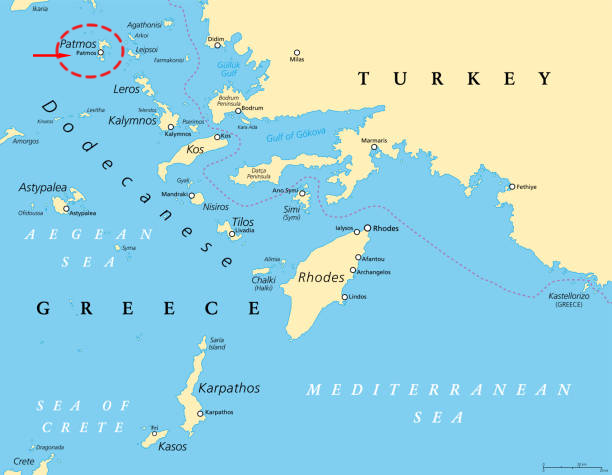
All too soon it was time to say goodbye to David as he departed for his journey back to the UK and we headed off eastwards to make our way across the Aegean to Turkey where we planned to spend the month of August. Our check out point from Greece was to be Patmos, the north most island in the Dodecanese group of islands in Greece which run down the Aegean coast of Greece/Turkey.
Our route took us to the Island of Patmos for a few days where we anchored in an almost deserted bay away from the main harbour/town of Skala. In the cool of the evening we hiked up a dirt road from the beach and walked a couple of kilometres along the main road to the small local town of Kampos in the hills with one restaurant and a chance to sample some authentic local peasant fare – goat casserole (katsikisio stifado). We should have realised that there would be a lack of street lights on our walk back to the boat past the local cemetery and a ‘stairway to heaven’ which looked more like an OH&S nightmare!
We visited the fortress-like Monastery of Saint John which dominates the skyline above Chora, the capital town. It is a fully functioning monastery where monks live and go about their daily lives therefore there a lot of restrictions on access to most areas. The monastery contains a museum and second the largest collection of religious texts and artefacts of the Greek Orthodox faith – the largest being housed in the Monasteries of Mount Athos in northern Greece. Below the monastery is a pathway leading to the small Greek Orthodox chapel of St Anne, constructed in the early 17th century which completely encloses the Cave of the Apocalypse, where the Apostle John is said to have had visions he interpreted as the final judgement (apocalypse) and now form the closing pages of the New Testament’s Book of Revelations.
Didim, Turkey

After waiting for a couple of days for the weather to settle down we checked out of Patmos (Greece) and before first light we headed off on our 7 hour journey to Didim on the coast of Turkey where we planned to check in.
Officialdom
In contrast to Greece where you can complete your check-in/out documents yourself, when you arrive in Turkey you are required to engage an Agent to handle your paperwork because the authorities will just ignore you waiting in their offices and will tell you to go away and get an agent. Job creation? For this privilege expect to pay anything between EUR 100 and EUR 500 – there are no fixed fees and as with most things it pays to negotiate.
Checking-In involves immigration – to present your passport and purchase a visa (if required); Customs to check your boat’s registration and validity; Port Authorities to check you have current boat insurance and a Captain’s Licence and if all is good you will be issued your Transit Log and a ‘Blue Card’ paper with QR code. Turkey requires all foreign boats to have black water tanks (poo) which need to be pumped out every 14 days for a small charge (officially TRY 250 – about EUR 7 but almost always you are charged whatever the operator feels like charging on the day!) and the details are entered into the computer system via your QR code. There is a huge fine for non compliance (in the 1000’s) but like many rules in this part of the world the idea is great but lacks execution with so many of the pump out stations being out of service – sometimes for years at a time – but no worries, you can usually get a ‘technical pump out’ where someone with the licence charges a premium for doing the paperwork and logging your QR code without actually emptying your tanks – and you satisfy the authorities requirements.

Our Agent in Didim, Attila, was quite efficient and we were all finished in a couple of hours and EUR 200 later (this was his secret discount!). We were joined at anchor in the harbour by our Kiwi friends, Russ and Cathie Prior on their boat Vanilla. The wind was howling, it was miserably hot in the high 30’s and apart from the constant movement and chop, we were inundated by biting flies! We only stayed here overnight and moved on the following day to more scenic places.
Our journey down the coast took us through acres of fish farms. The farms were originally established in sheltered coves and calm water areas but over recent years they have been gradually moved out into more open areas allowing the operators to move the fish pens on a regular basis to prevent the build up of excess nutrients and detritus from the fish life cycle.
The wind continued and as we made our way south the flies disappeared – yay! The whole of Europe has been effected by heatwave, wildfires and now flies! We stopped at some beautiful small bays, clambered over some interesting ruins, enjoyed delicious Turkish food, John had a genuine Turkish barber experience and we watched with fascination as huge water bombing planes dipped down over the yacht masts to fill up with water and return to a firefront near Bodrum airport quite close by.
Our next major stop will be Bodrum where we say goodbye to Steve and hello darling daughter!!
3 comments